


If you have ever stood in your bathroom at eight o'clock on a Saturday morning, holding a toothbrush, a tube of vinegar, and a bottle of grout cleaner, trying to convince yourself that this is self-care, you already know what this product is for. The shower tile looks clean from across the room. It looks clean when the light is off. It looks clean when you are in a hurry. But the moment you get on your knees, get your face close enough, and actually look, you see it: a faint gray-brown line between every tile, darker in the corners, almost black where the tub meets the wall, streaked around the faucet, speckled along the caulk. That is not dirt on the surface. That is dirt in the grout — and grout is porous, which means it absorbs water, soap, body oil, and mildew spores every single time you shower, and releases nothing back.
You cannot wipe grout clean with a cloth. You cannot spray it away with a bottle. You cannot vacuum it. You cannot steam it away without a two-hundred-dollar machine. What you can do is get down on your hands and knees, put your weight into a small brush, and scrape that line out, bristles against grout, one tile at a time. That is the bathroom problem nobody posts about. People post about renovated bathrooms. They post about marble counters. They do not post about the forty minutes they spent on their knees, scrubbing the grout around the toilet, because it sounds exactly as miserable as it is.
This is where a floor scrub brush stops being a "nice to have" cleaning tool and starts being the one object in your bathroom that was actually built for the job. Not a sponge. Not a toothbrush. Not an all-purpose cloth. A short, wide, stiff-bristled brush with a contoured grip, designed to take your palm weight and transfer it directly onto a hard surface — tile, grout, sink, tub, counter, shower wall — so that the scraping happens in a few strokes instead of forty minutes of frustration.
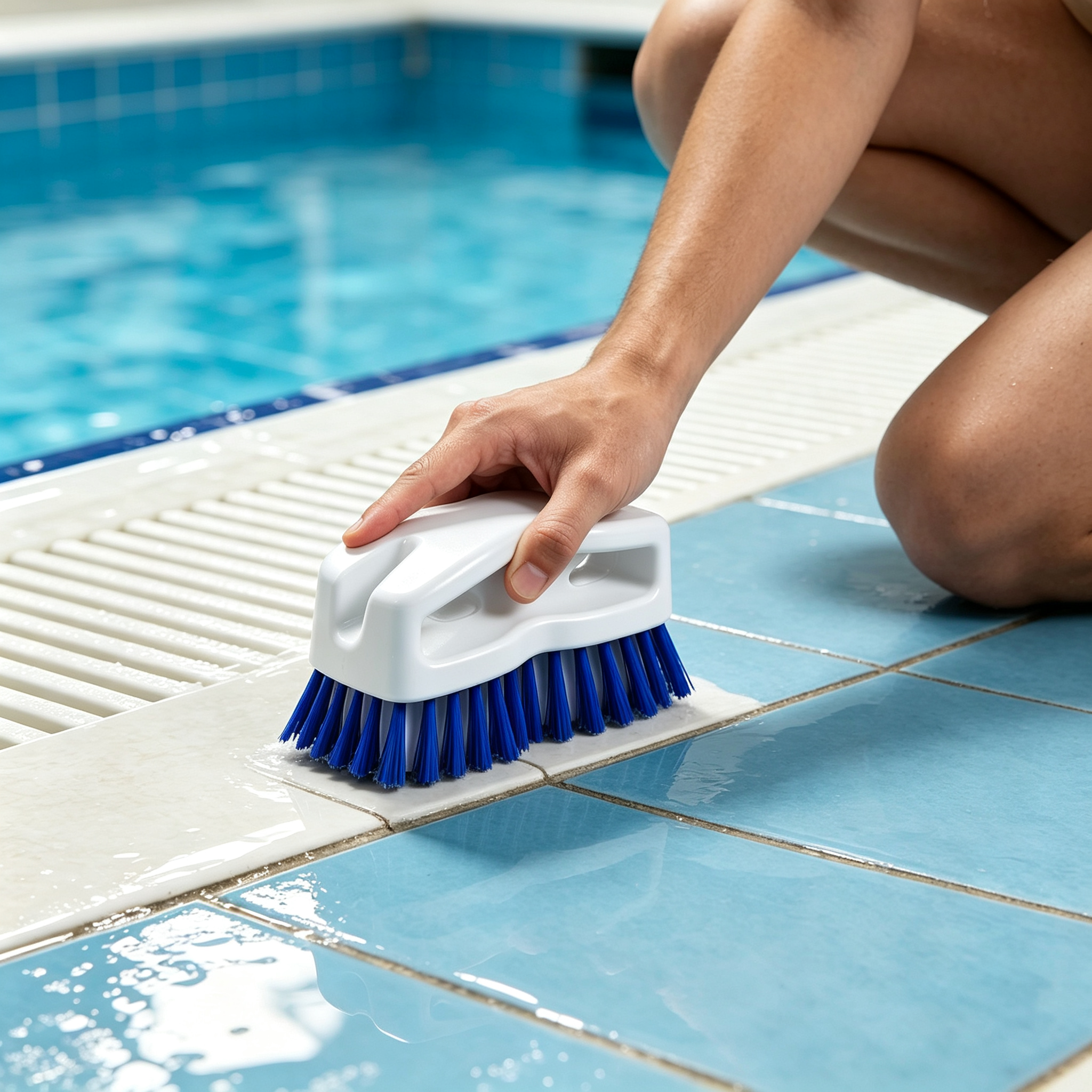
The Bathroom Problem Nobody Talks About, But Everyone Lives With
If you have ever stood in your bathroom at eight o'clock on a Saturday morning, holding a toothbrush, a tube of vinegar, and a bottle of grout cleaner, trying to convince yourself that this is self-care, you already know what this product is for. The shower tile looks clean from across the room. It looks clean when the light is off. It looks clean when you are in a hurry. But the moment you get on your knees, get your face close enough, and actually look, you see it: a faint gray-brown line between every tile, darker in the corners, almost black where the tub meets the wall, streaked around the faucet, speckled along the caulk. That is not dirt on the surface. That is dirt in the grout — and grout is porous, which means it absorbs water, soap, body oil, and mildew spores every single time you shower, and releases nothing back.
You cannot wipe grout clean with a cloth. You cannot spray it away with a bottle. You cannot vacuum it. You cannot steam it away without a two-hundred-dollar machine. What you can do is get down on your hands and knees, put your weight into a small brush, and scrape that line out, bristles against grout, one tile at a time. That is the bathroom problem nobody posts about. People post about renovated bathrooms. They post about marble counters. They do not post about the forty minutes they spent on their knees, scrubbing the grout around the toilet, because it sounds exactly as miserable as it is.
This is where a floor scrub brush stops being a "nice to have" cleaning tool and starts being the one object in your bathroom that was actually built for the job. Not a sponge. Not a toothbrush. Not an all-purpose cloth. A short, wide, stiff-bristled brush with a contoured grip, designed to take your palm weight and transfer it directly onto a hard surface — tile, grout, sink, tub, counter, shower wall — so that the scraping happens in a few strokes instead of forty minutes of frustration.
Why a Scrub Brush, Not a Sponge, Not a Spray, Not a Steam Mop
You already own four other things that are supposed to clean your bathroom. Let us be honest about each of them.
The sponge. Sponges are excellent at spreading wetness. They are mediocre at removing anything that has bonded to a surface. Press a sponge against a gray grout line, and you will see the dirt smear sideways onto the tile. Press it again, and it will absorb some of the water, but the brown line will still be there when it dries. Worse, sponges become bacterial factories after two weeks. By the time your grout looks the same as it did before, your sponge is doing more microbiology than cleaning.
The spray bottle. Sprays and foams and gels are chemistry. They sit on a surface and dissolve minerals over ten, twenty, thirty minutes. That works — if you then agitate the surface with something mechanical. Sprays without scrubbing are the most expensive wet napkins on the market. Read the back of the bottle: it almost always says "scrub with a brush." The bottle is half of the job. The brush is the other half, and the half no one wants to buy.
The steam mop. Steam mops are magnificent on sealed hard floors. They are also expensive, heavy, require water tanks, and cannot get into the corners around the toilet, the lip of the sink, or the vertical shower wall at shoulder height. They clean a horizontal surface; they do not scrub a grout line.
The electric spin brush. Battery-powered spin brushes are a real category, and they work. They also need charging, die mid-job, and vibrate hard enough to numb your hand for an hour afterward. For a thirty-minute bathroom deep clean every two weeks, a manual brush with stiff bristles does the same mechanical work, at one-tenth the price, with no battery to die.
A dedicated scrub brush, with stiff angled bristles and a grip that takes the weight of your hand, is the missing tool. It is not a replacement for spray chemistry. It is the part of the job that chemistry alone cannot do.
What 2026 Actually Demands From a Cleaning Brush
Three years ago, a cleaning brush was a commodity. You bought the cheapest one at the grocery store, used it until the handle broke, and replaced it. That era is over. The 2026 buyer has done the reading. They have watched enough cleaning TikTok to know that "stiff bristles" is not a marketing phrase — it is a spec. They know that soft bristles move soap around, that medium bristles are for dishes, and that only hard, angled, densely packed bristles actually cut through soap scum and mildew in grout.
They also care about ergonomics. The 2026 homeowner is, statistically, getting older. A huge portion of the people cleaning bathrooms today are forty-five to sixty-five, and they have backs, knees, and wrists. The brush that requires them to grip it like a toothbrush and scrub with wrist-only pressure is the brush they will use twice and then abandon in the under-sink cabinet forever. What they actually need is a brush they can hold with the whole palm, a brush whose grip follows the shape of a hand pushing down, a brush that lets the weight of the arm do the work instead of the tendons.
They care about versatility. Nobody in 2026 wants six separate brushes under the sink — one for the toilet, one for the tub, one for the counter, one for the floor, one for the tiles, one for the faucets. That is a cabinet full of tools and no system. What they want is one brush that does all six, with a bristle density and angle that works on horizontal tile, vertical tile, curved sink interiors, and the narrow grout line around the base of the toilet.
They care about hygiene. A brush that sits wet in a corner grows mold on its own handle. A brush that can be rinsed, shaken, and left standing bristle-up to dry is a brush that will not smell after a month. A brush whose plastic is one solid piece, with no crevice where soap can dry into a crust, is a brush that survives years.
They care about value. The 2026 consumer is not cheap, but they are done buying disposable. A scrub brush that lasts three years is not a thirty-dollar purchase; it is a ten-dollar-a-year purchase. That math is the math they want to see on the product page.
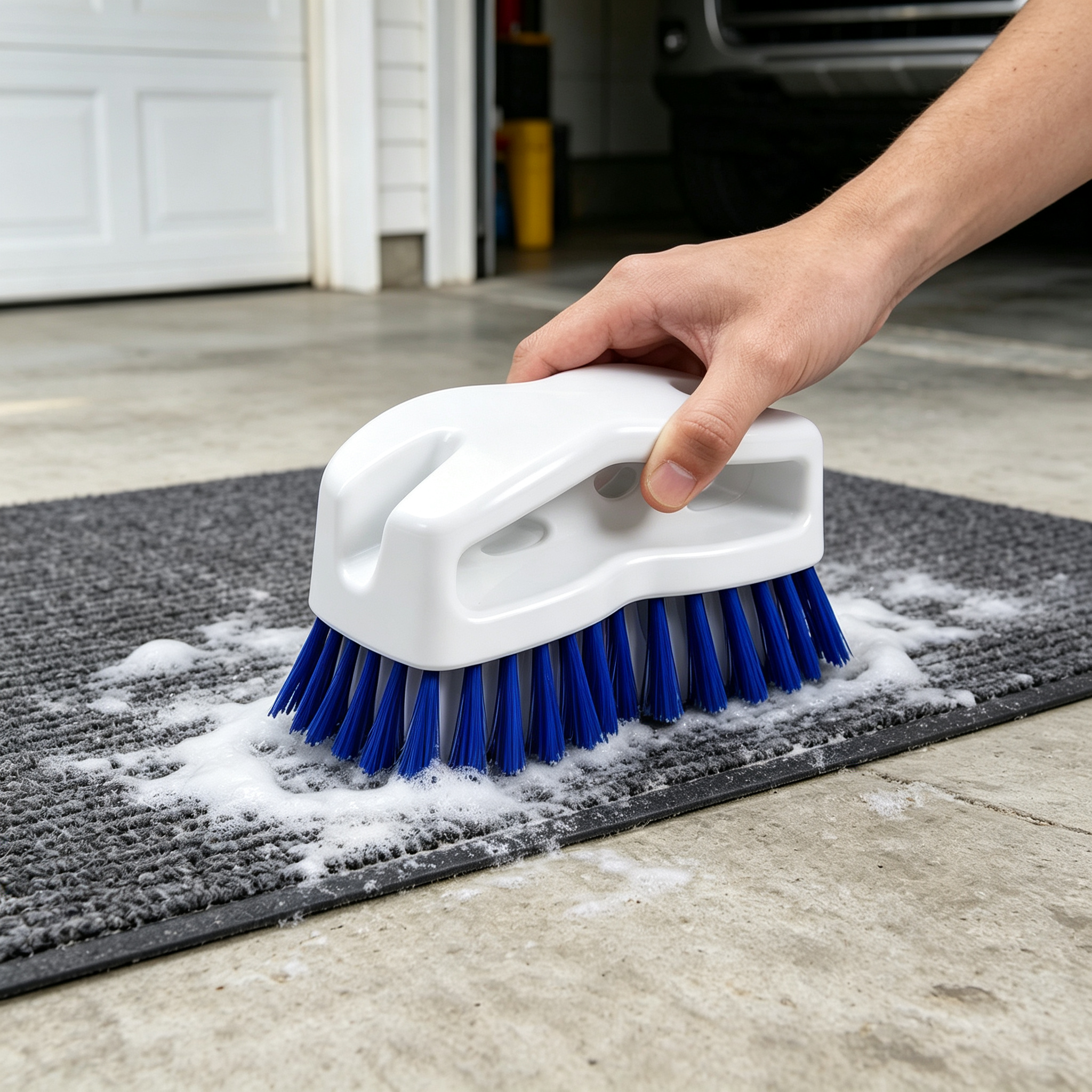
Anatomy of the 2026 Floor Scrub Brush
Let us be precise. This is a hand-held scrub brush. The body is molded white plastic with a contoured, open-frame grip that fits four fingers underneath and the palm on top. The bristle block is dense, straight, stiff blue nylon filaments cut at a slight angle, packed close enough to dig into grout but firm enough not to fan out under pressure. The brush head is rectangular, about the width of a palm, built to cover a few tiles in each pass without being so wide that it cannot fit into the corner where the wall meets the tub. The packaging is a blue-and-white retail box with the product on the front and the six surfaces it works on listed on the side. No batteries. No moving parts. No chemicals. It is, honestly, a plastic block and a bundle of stiff fibers. That is the whole invention. The question is whether those fibers are the right stiffness, in the right density, at the right angle, on a grip that lets you push.
Let us break it down.
The grip. The white body is shaped so that when you press down, your palm sits on the top ridge, your four fingers lock into the open frame underneath, and your thumb braces the side. This is not a toothbrush grip. This is a push grip. When you lean your body weight onto it, the grip transfers that weight straight down into the bristles, instead of into your wrist. That single geometry is the difference between scrubbing for three minutes and scrubbing for thirty.
The bristles. Blue, stiff, cut straight, densely packed. Stiff is the word. Soft or medium bristles are for dishes and countertops. For grout, for soap scum, for the ring around the toilet base, you need bristles that do not bend sideways when you push. They should dig, not bow. The angle — cut slightly forward — is what lets the leading edge bite into the grout line while the rest of the block sweeps the tile face.
The head. A rectangular palm-sized block. Wide enough to cover three to four tiles per pass. Narrow enough to fit between the toilet and the tub, to reach the narrow strip behind the faucet, to work on the curved interior of the sink. Not a giant deck brush. Not a tiny detail brush. The size that hits the middle of the useful range.
The material. Molded plastic, one piece, no glued parts, no rusting metal, no wood that swells. A plastic that does not yellow under bathroom light. A plastic that survives drops onto tile. Bristles that do not shed after ten uses.
The six surfaces it is built for. The marketing panel says it plainly: countertops, faucets, tiles and walls, sinks, toilets, bathtubs. That list is the product. It is not a floor deck brush. It is not a dish brush. It is a bathroom-and-kitchen hand scrubber that happens to also do the floor.
Ten Surfaces, One Brush: Where It Earns Its Place
Let us walk the list the way you would actually use it on a Saturday morning.
1. Countertops. The kitchen counter after cooking. Crumbs are easy; dried sauce, coffee rings, and flour baked into the seam between the counter and the backsplash are not. A few passes with the scrub brush, bristles angled into the seam, and the crusted stuff lifts. No more toothbrush.
2. Faucets. Around the base of the faucet, where the spout meets the sink, the hard water ring is the classic missed spot. The bristle block reaches into the curve where a sponge cannot, the stiff fibers dislodge the mineral ring, and a rinse leaves the chrome bright.
3. Tiles and walls. Shower tile, bathroom wall tile, kitchen backsplash. The vertical surface is where a short brush beats a long one: you hold it in your hand, push it against the wall, and the grip lets you press. The angled bristles dig into the grout line as you pass.
4. Sinks. Inside the sink — porcelain, stainless, composite. The curve at the bottom, the rim where water pools, the overflow hole rim. Stiff bristles lift the ring that a cloth leaves behind.
5. Toilets. Exterior first. The base where the toilet meets the floor — that is the grout line nobody scrubs. The side of the bowl above the waterline. The hinge area between the seat and the lid. Stiff bristles and a little disinfectant.
6. Bathtubs. The ring around the tub, where the waterline sits. The curved interior wall. The seam between tub and tile. This is the single most satisfying use: a dozen passes, and the brown ring lifts into gray suds.
7. Shower floor. The tiled shower floor, drained wet, soap scum pooled in the texture. You can stand or kneel, but with the push-grip you do not need to grip hard.
8. Baseboards and wall corners. Where wall meets floor. The narrow line where dust and cobwebs collect.
9. Outdoor and patio tile. Summer patio furniture grime, the walkway pavers. A stiff brush is the only tool that does not smear wet.
10. Garage and entry floor. The tile or vinyl entry floor where shoes bring in winter salt and mud. A quick scrub before guests arrive.
Honest Comparisons: Why a Manual Brush Wins
Against a toothbrush. Toothbrushes are for detail work. They are also, frankly, terrible tools for a 300-square-inch shower. You will be on your knees for an hour, your wrist will ache, and the toothbrush will fray in a week. A scrub brush covers in one pass what a toothbrush takes ten.
Against a sponge. Sponges wet, spread, and smear. They do not have the stiffness to agitate grout.
Against a magic eraser. Magic erasers are melamine foam, which works by abrasion. They scratch chrome, they dull acrylic tubs, and they dissolve after two showers. A bristle brush is reusable, non-abrasive on the surfaces that matter, and does not melt.
Against an electric spin brush. As we said, electric is great, but the cost, the charging, the vibration fatigue, and the dead battery at minute twenty make it a weekend-warrior tool, not a Tuesday-evening tool. For the 90 % of bathroom cleaning that is between deep cleans, a manual brush wins.
Against a long-handle deck brush. Long handles are great for open floors. They are terrible for inside the sink, around the faucet, on the shower wall, and around the toilet. A hand brush reaches the places a long handle physically cannot.
The Method: Scrub Like a Professional
The brush is cheap. The technique is free. Three rules separate a clean bathroom from a half-clean bathroom.
First, wet the surface first, and let chemistry sit. Spray your cleaner, wait three to five minutes, and then scrub. Scrubbing a dry, dirty surface just pushes the dirt around. Scrubbing a chemical-saturated surface lifts it.
Second, use your body weight, not your wrist. Grip the frame with four fingers underneath, palm on top, and lean. The bristles should be doing the work, not your forearm. If you are flexing your wrist, you are doing it wrong.
Third, rinse as you go. Dip the brush in a bucket of clean water every few passes. A caked bristle block stops cutting. Rinse, shake, go back.
Six Mistakes That Waste the Brush
One: using it on polished marble or natural stone without checking the sealer. Stiff bristles can dull unsealed stone. Test an inconspicuous corner.Two: scrubbing dry. Always wet.Three: storing it bristle-down in a corner. That grows mildew on the handle. Store it bristle-up, or hang it.Four: using the same brush for toilet and counter without rinsing between. The point of a dedicated brush is hygiene.Five: pressing so hard the bristles fan sideways. You want them vertical, digging, not bowed.Six: expecting the brush to do chemistry. It lifts; the spray dissolves. Use both.
Why 2026 Is the Year to Buy It
Three forces converge. First, the post-pandemic home-hygiene wave has not reversed; it has matured into "I know what a grout line is and I want it white." Second, the generation doing the household buying is forty-five to sixty-five, and that demographic will no longer kneel on bathroom tile for fun. Third, the clean-girl cleaning era on social media has taught the buyer that the brush, not the bottle, is where the work actually happens.
A stiff-bristle, push-grip, six-surface scrub brush is the tool that era has been asking for.
The Bottom Line
A scrub brush is a block of plastic and a tuft of blue fibers. That sentence makes it sound small. What it actually is, in 2026, is the fifteen-minute answer to a problem you have been accepting for years: the brown line in your grout, the ring around your tub, the invisible gray film on your faucet, the corner behind the toilet that no spray bottle has ever reached. The brush does not do the chemistry. It does the part the chemistry cannot — it puts the abrasive contact where the gunk actually lives, one push at a time, on any surface in the bathroom or kitchen, for years, with no battery to die and no box to replace.
Make 2026 the year your grout line stops being a place you avoid looking at. Because the bathroom you actually live in deserves better than the one you are pretending to have.



