


In 2026, the average Western home is a loving home. Sixty-six percent of U.S. households own at least one pet (American Pet Products Association, APPMA), the European Union is approaching 46% pet-owning households (FEDIAF), Japan has more pets than children, and South Korea's pet-owning households have crossed 40%. We love them. We sleep with them, we let them on the sofa, we hand-feed them treats, and we drive them to weekend getaways.
And then we open the closet. The black blazer you wore last week is gray. The cream sweater has a new terracotta pattern that wasn't on the tag. The passenger seat looks like a small mammal exploded on it. The duvet cover is no longer white. Your guests, standing at the front door, are already running their eyes over your couch — and finding someone else's hair there, too.
This is not a cleanliness problem. It is a physics problem. Pet hair does not sit on fabric — it embeds. Cat undercoat and dog fur are designed to lock into textiles: they catch on carpet loops, wedge into woven upholstery, sink between knit fibers, and grip leather seats. A regular pass with a cloth does nothing. A vacuum, even on full suction, lifts only the surface layer — the embedded hair stays, feeding the next shedding cycle. And short-handled lint rollers, the ones you have to crouch, kneel, and stretch to use, were designed for a world where bending down was a free move. It isn't. Bad backs, bad knees, and a household of 500 square feet that needs doing in ten minutes means the job either gets done badly — or doesn't get done at all.
That is why, in 2026, the lint roller finally grew a handle.
The hair on everything that isn't the pet
In 2026, the average Western home is a loving home. Sixty-six percent of U.S. households own at least one pet (American Pet Products Association, APPMA), the European Union is approaching 46% pet-owning households (FEDIAF), Japan has more pets than children, and South Korea's pet-owning households have crossed 40%. We love them. We sleep with them, we let them on the sofa, we hand-feed them treats, and we drive them to weekend getaways.
And then we open the closet. The black blazer you wore last week is gray. The cream sweater has a new terracotta pattern that wasn't on the tag. The passenger seat looks like a small mammal exploded on it. The duvet cover is no longer white. Your guests, standing at the front door, are already running their eyes over your couch — and finding someone else's hair there, too.
This is not a cleanliness problem. It is a physics problem. Pet hair does not sit on fabric — it embeds. Cat undercoat and dog fur are designed to lock into textiles: they catch on carpet loops, wedge into woven upholstery, sink between knit fibers, and grip leather seats. A regular pass with a cloth does nothing. A vacuum, even on full suction, lifts only the surface layer — the embedded hair stays, feeding the next shedding cycle. And short-handled lint rollers, the ones you have to crouch, kneel, and stretch to use, were designed for a world where bending down was a free move. It isn't. Bad backs, bad knees, and a household of 500 square feet that needs doing in ten minutes means the job either gets done badly — or doesn't get done at all.
That is why, in 2026, the lint roller finally grew a handle.
Why a sticky roller, and why long-handled
Two honest questions deserve honest answers before we go further: Why a sticky roller at all, when you own a vacuum? And why a long handle, when a short one has been selling for fifty years?
The first question has a physics answer. Vacuums are suction machines; they are excellent at loose dust and crumbs and mediocre at hair embedded in fabric. Pet hair is electrostatic and fibrous: it clings, it tangles, and it resists upward pull. A sticky adhesive layer, by contrast, grabs on contact — one pass, and the hair is physically peeled off the weave. Dermatology and allergy literature has long noted that pet dander is one of the most common indoor allergens, and that mechanically removing hair and dander from upholstery reduces airborne allergen load; a roller does that contact-by-contact, on demand, between vacuum days. You do not need to drag the vacuum out at 8 a.m. before a meeting. You do not need to wake the sleeping dog. You uncap the roller, roll, peel, and move on.
The second question has a body answer. Short-handled rollers are 20–25 cm long. To use one on a carpet, a bed, or the lower half of a sofa, you must bend from the waist, kneel, or perch on the floor. Multiply that by a weekly household — two couches, a king bed, a car seat, a rug, a wool coat — and you have a job that adds up to twenty minutes of spinal flexion a week, every week, year after year. Ergonomists have been saying for decades that repetitive forward flexion is one of the highest-risk motions for lower-back strain. A long-handled roller turns the same job into a standing, arm-level movement: you roll the carpet standing up, you roll the bed edge from a standing position, you roll the car seat from outside the door. You do the same physical work, but your spine stays neutral.
That is the 2026 upgrade story. Not "a better sticky sheet." A better lever.
The American 2026 moment: pet culture, CleanTok, and the rise of the one-pass home
Timing matters. In the United States, pet ownership is now mainstream rather than niche: the APPMA figures put dog ownership alone at roughly 45% of households and cat ownership at roughly 25–30%, with spending on pet supplies climbing into the tens of billions of dollars every year. For a large part of this audience, the pet is not an accessory — it is a family member, and the "pet parent" vocabulary (spoiled fur baby, furchild, dog mom) is now fully normalized in advertising.
That shift has created a specific consumer: someone who will not tolerate the appearance of a home that looks "lived-in by a large animal." They will post their apartment on social media. They will host guests. They will put on a black blazer after walking the dog. They need a clean that happens between professional cleanings — and they need it fast.
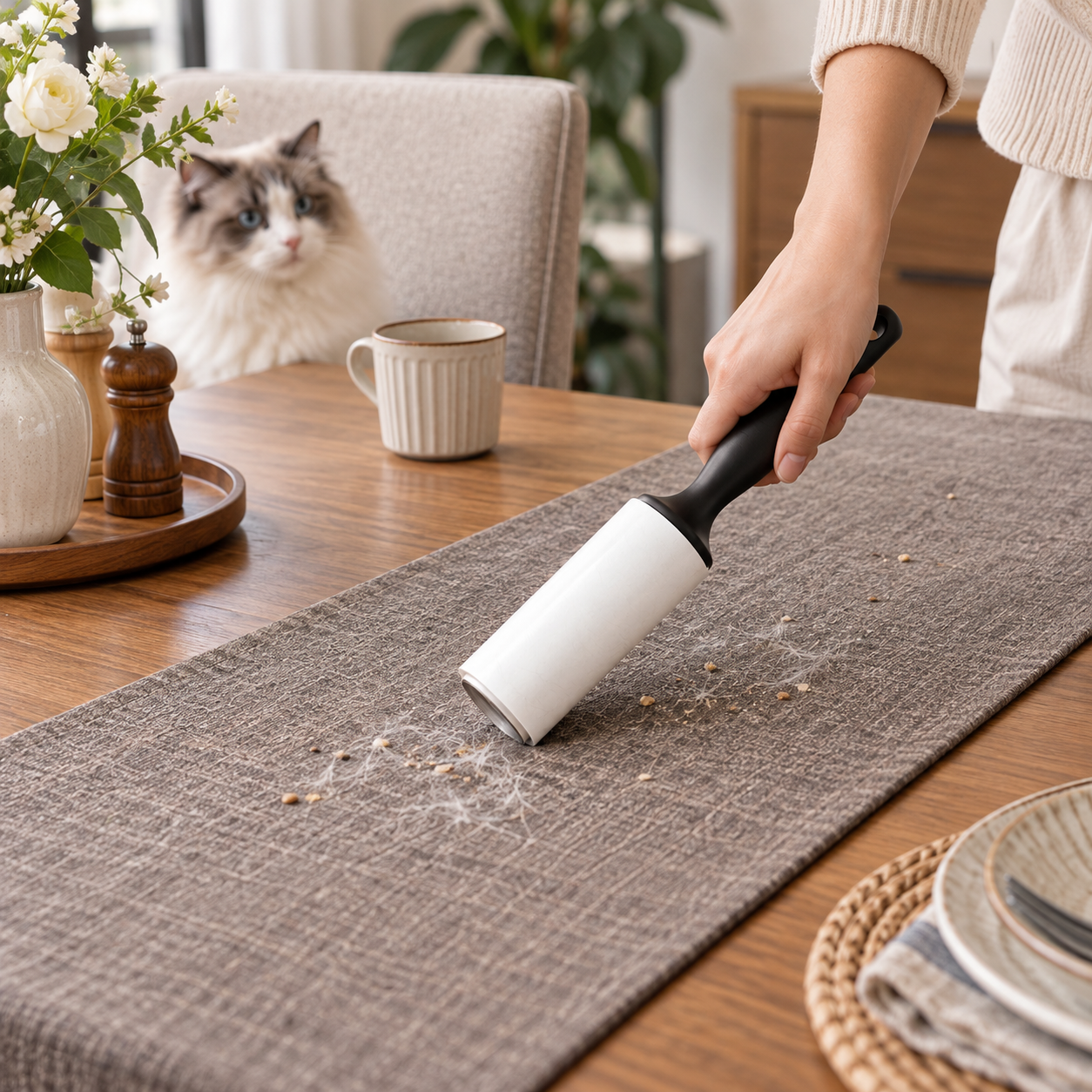
This is the audience that made CleanTok and pet-parent content a permanent category. On TikTok, #PetHair and #LintRoller content has long had a steady, high-conversion audience: short clips of a roller pulling a visible mat of cat hair off a black sweater, or off a car seat, are the kind of before/after that converts. They are satisfying because the result is immediate and visible. You roll — and you see, on the sheet itself, exactly how much you just removed. No other cleaning tool gives you that receipt.
The American 2026 buyer is also an aging buyer. Millennials are now in their thirties and forties; the generation that pioneered pet-parent culture is now the generation that feels their back. "No bending" is no longer a nice-to-have; it is the reason a product gets picked up off the shelf instead of the old short-handled pack. The long-handled roller, in other words, is not a new gadget for early adopters. It is the obvious evolution for a market that has finally aged into needing it.
Anatomy of the 2026 long-handled lint roller
Let's be precise about the tool. This is a handheld lint roller with a hanging-loop ergonomic handle, a 5 cm × 23 cm adhesive sheet roll, sixty tear-off sheets per roll, and a refillable design. The packaging is plain white with a deep-purple accent, marked "LINT ROLLER," "60 SHEETS," and the dimensions "5cm × 23cm." It is, in every sense, the honest version of the product — no gimmicks, no battery, no motor. What it does, it does on contact.
The handle. A matte-black, contoured grip with a hanging loop at the top. The loop is the detail people forget: it means the roller lives on a hook by the door, in the closet, or in the car — not buried in a drawer, which is where cleaning tools go to never be used again. A tool you can reach for in two seconds is a tool you actually use.
The adhesive sheet. The working end. A 5 cm wide × 23 cm long roll of sticky paper, split into sixty perforated tear-off sheets. The width matters: 23 cm covers a good strip of sofa or carpet in one pass, which is what separates a roller that "takes forever" from one that feels instant. The adhesive is designed to lift hair, lint, and dander without leaving residue on fabric — the thing a cheap roller does, and the reason people hate them.
The refill system. When the sheet runs out, you replace the roll — not the whole handle. This is the environmental and economic argument: a durable handle plus cheap refills beats single-use throwaway rollers every year. It is also the answer to the eco-conscious buyer, who has every right to ask why a cleaning product should be plastic.
The six surfaces it was built for. The marketing graphic lays it out plainly: Clothing, Bedding, Sofa, Car Interior, Pet Hair, Carpet. That list is the product. It is not a garment-only roller. It is a whole-home, whole-car hair remover.
Ten surfaces, one tool: where it earns its place
The point of a long handle is that surfaces which used to require bending are now standing jobs. Walk through the list.
1. Clothing — the blazer test. The use case everyone recognizes. Black, navy, cream: the colors that show every hair. Roll once down the sleeve, once across the shoulder, once across the lapel. The hair comes off on the sheet, visibly, in one pass. This is the two-morning-a-week moment that justifies the product alone.
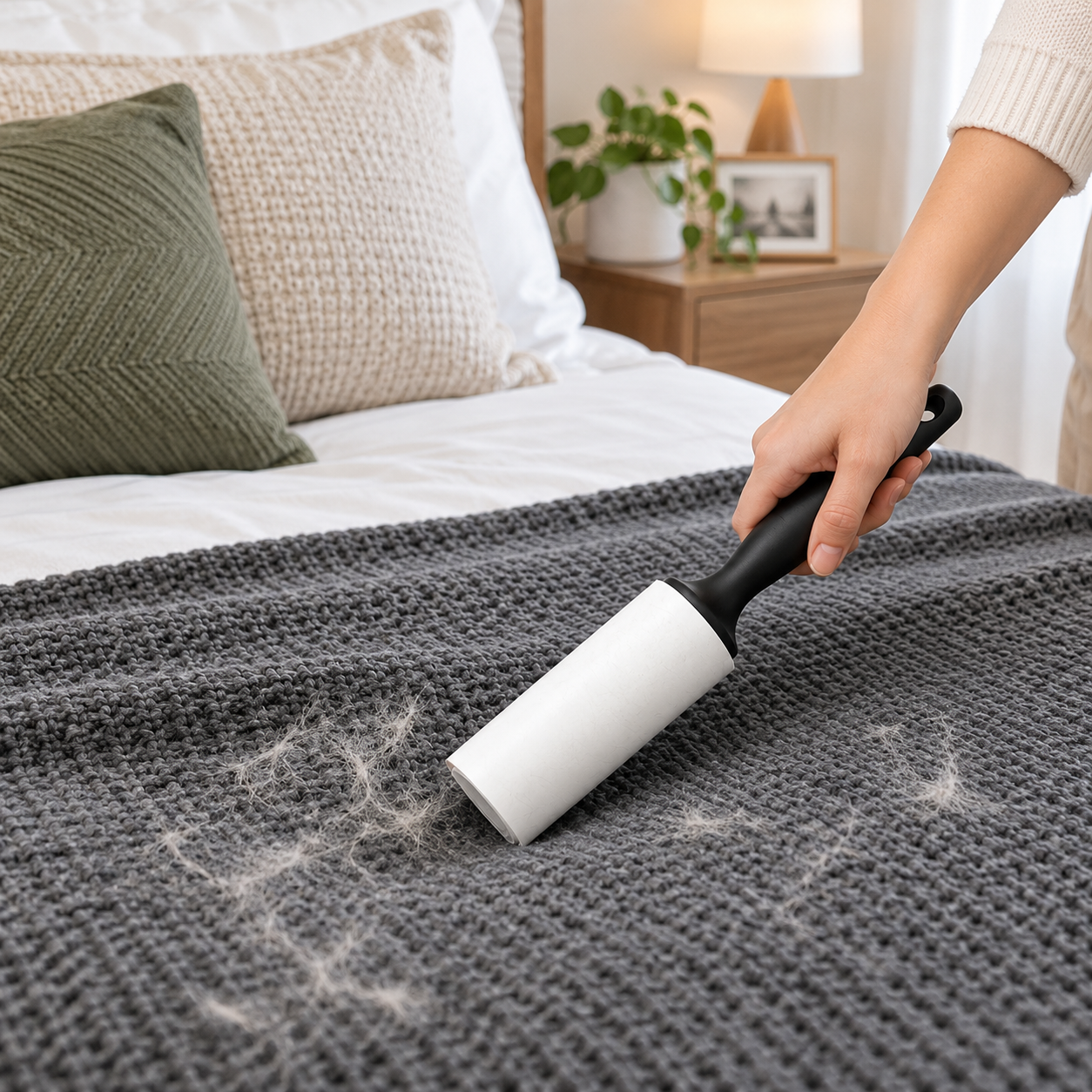
2. Bedding. Duvet covers, pillow shams, mattress tops. Pet owners know the dog sleeps on the bed half the week; the duvet looks fine in the morning and is hair-thick by evening. A standing, long-handled roll over the top of the bed — no climbing on, no kneeling — pulls the top layer off in minutes.
3. Sofa. The most-visible surface in the house. The cushions where the cat sits every evening are, by evening, a solid gray. Roll along the grain of the fabric, back and forth. The sheet fills visibly; you peel and continue.
4. Car interior. The passenger seat and the back seat. Leather, vinyl, cloth — all take a roller well, and none of them tolerate a vacuum well (it's loud, it's corded, it's in the garage). Standing outside the open door, roll the seat from the headrest down. No bending into the footwell.
5. Pet hair — direct on the source. Right after the dog comes in from the yard. Roll over a dog's back or a cat's favorite cushion while they are still warm on it. (Always roll with the coat, gently, and watch the animal's reaction; many pets actually enjoy the sensation.)
6. Carpet. The low-pile area rug by the door, the runner in the hallway. A long handle turns carpet rolling into a standing chore, like sweeping — you walk backward across it, rolling as you go.
7. Stair runners. The classic bending job. Long handle = standing on one step, reaching the next. No more kneeling on stairs.
8. Car floor mats. Pull them out, lean against the bumper, roll them standing up.
9. Office chair & car headliner fabric. The fabric headliner above the driver's seat picks up dust and hair nobody sees until the sunlight hits it.
10. Luggage & coats between seasons. Off-season wool coats, suitcase interiors, throw pillows on the patio furniture — anything fabric that has sat.
Honest comparisons: why the roller wins where the vacuum and the brush lose
Against the vacuum. The vacuum is the right tool for loose debris and deep carpet. It is the wrong tool for a black blazer before a meeting. It is corded, heavy, loud, and it only lifts what is on the surface. A roller is the right tool for targeted, on-demand, contact cleaning — and the two are not competitors, they are shifts. The vacuum weekly; the roller between.
Against a rubber brush or glove. Rubber deshedding brushes work great on the pet itself and poorly on upholstery. They push hair around rather than lifting it, and they need a rinse after every pass. A roller is dry, fast, and disposable-sheet-clean.
Against a short-handled roller. Same adhesive, same width — but every surface below waist height now requires your body to get on the floor. The long-handled version is the same tool, at standing height. For anyone with a bad back, bad knees, or a time budget, it is not an upgrade; it is the difference between doing the job and skipping it.
Against lint remover shampoo or fabric sprays. Sprays treat static; they do not remove hair. A roller removes hair, mechanically, now.
The method: roll like a professional
The tool is cheap; the technique is free. Three rules separate a fast, clean result from a half-done one.
First, always roll in one direction, with the fabric grain. Back-and-forth scrubbing tangles the hair and pushes it back into the weave. Long, single passes forward, lifting the roller at the end of each pass, shed the hair onto the sheet.
Second, peel when the sheet is full, not when it is saturated. A covered sheet has no adhesive left — you are just pushing hair around. When the visible sheet has roughly one layer of hair across its face, peel to the next. Sixty sheets is plenty if you peel at the right moment; wasteful if you peel after every pass.
Third, do the car and the bed last, the clothing first. The blazer takes thirty seconds and removes a morning-of-embarrassment risk. The sofa takes five minutes and removes a "I should clean before guests come over" dread. Order your day by what is about to be seen.
Six mistakes that waste the roller
One: scrubbing back and forth. It tangles. Single forward passes only. Two: peeling too often. You burn sheets and it costs more. Three: rolling wet fabric. Adhesive dissolves; you ruin the roll. Fabric must be dry. Four: using it on leather as a substitute for conditioner. It removes hair, not oil or scratches. Five: storing it open. The sheet dries out. Keep the cap on, or store it loop-side down. Six: expecting it to replace a vacuum deep clean. It is a between-cleaning tool, not a cleaning cycle.
Why 2026 is the year to buy this
Three forces converge in 2026. First, pet ownership keeps rising, and the homes that love their pets also refuse to look like they own them. Second, the pet-parent buyer is aging into backs that cannot bend. Third, the refill economy is now a buying criterion, not a footnote: a handle that lasts, refills that are cheap and easy to find, is the responsible purchase. The long-handled, refillable, sixty-sheet roller is the version of this product that the market has been asking for without quite asking.
Verdict
A lint roller is a sticky sheet on a handle. That sentence makes it sound small. What it actually is, in 2026, is the twenty-second answer to a problem you have already accepted: that your black blazer will be gray by evening, that your passenger seat will carry evidence of the dog, that your sofa will never be quite the color it was sold to you as. The long handle is the upgrade that lets you fix it standing up — in one pass, on every surface, for years, with a refill when the sheet runs out.
Make 2026 the year your couch stops looking like someone lives on it. Because someone does — and they deserve a clean seat too.



