


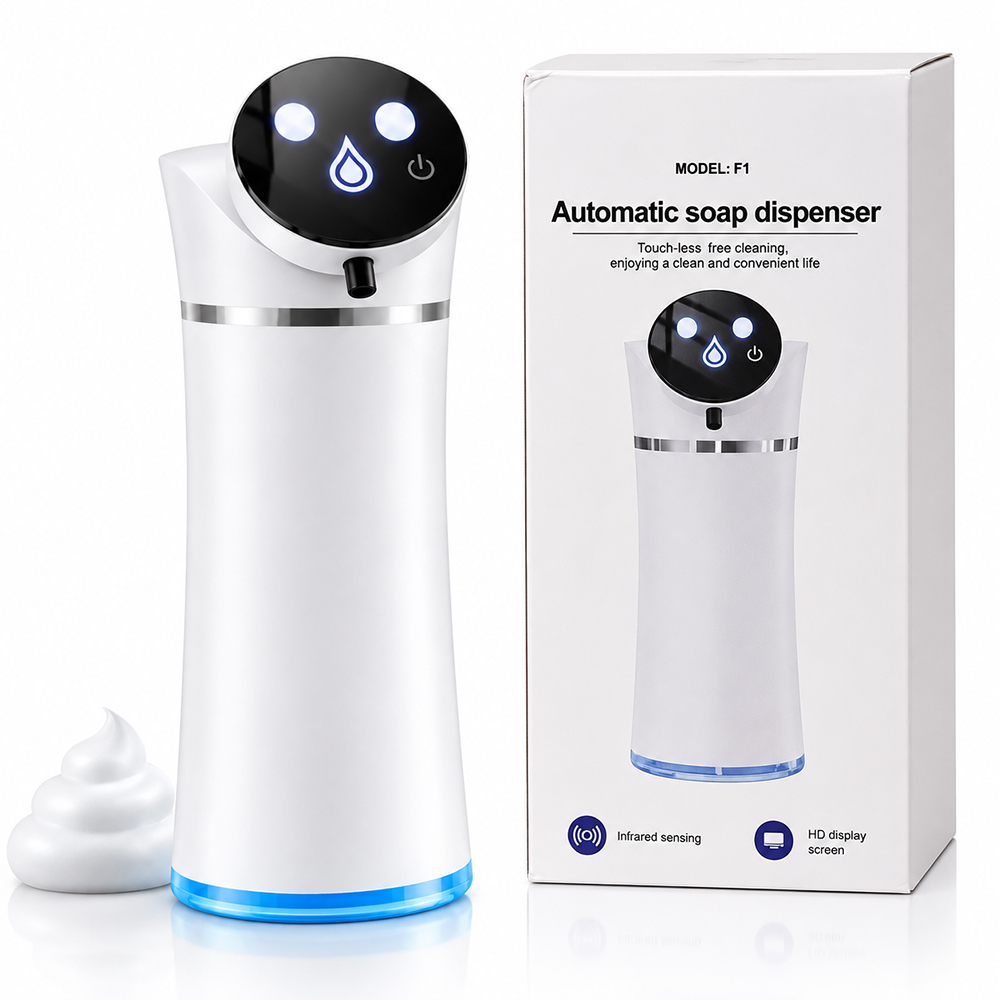
The home cleaning sector in 2026 is undergoing a quiet but profound transformation. When "clean" is no longer the only criterion, when consumers begin voting with their senses, and when hygiene protection in kitchen and bathroom spaces shifts from "post-cleaning" to "process interruption"—a previously overlooked yet critical category is stepping into the spotlight: rechargeable sensor soap dispensers. What it solves is far more than the act of "dispensing soap." It redefines the relationship between "hands" and "hygiene" in household kitchen and bathroom scenarios. For brands and channel partners looking for the next upgrade direction in home cleaning categories, understanding the logic behind this trend matters more than chasing any single bestseller.
Why "Touch-Free" Has Moved from a Bonus to a Must in 2026
To understand the market logic of sensor soap dispensers, one must first understand the structural shift in contemporary household hygiene perceptions. Authoritative international health organizations provide clear evidence. The World Health Organization (WHO), in its 2025 World Hand Hygiene Day theme, emphasized a core message: "Gloves may be contaminated, but hand hygiene is always essential." WHO explicitly stated that gloves do not provide 100% protection—proper hand hygiene practices are the critical link in breaking the chain of infection transmission. The significance of this authoritative statement lies in elevating "hand hygiene" from a personal habit to a piece of public health infrastructure.
And the entry point of that infrastructure is precisely the repeatedly touched pump head of a soap dispenser. CWS, a European professional hygiene solutions provider, presented a conclusion in its technical literature validated by extensive research: viruses and bacteria transmitted through hands are the second-largest source of infection after respiratory infections, and soap dispenser surfaces in public restrooms are often breeding grounds for pathogenic bacteria. Every press is a potential cross-contamination event. The value of touch-free dispensing is not "convenience"—it is physically severing this contamination chain.
Consumers in 2026 already have clear awareness of this. Industry observations published by Xinhua News indicate that the underlying logic of household cleaning consumption is upgrading from "completing cleaning tasks" to "comprehensive life management balancing efficiency, health, and emotional experience." This means that if a soap dispenser still requires manual pressing, it has already lost on two dimensions in consumers' minds: not healthy enough, and not effortless enough. International Online, citing Economic Daily, further confirms this trend: home cleaning demand is continuously segmenting by space, object, and usage scenario, with consumers aged 26 to 45 forming the market backbone, and product refinement and intelligent upgrades advancing in parallel. Sensor soap dispensers sit precisely at the intersection of "refinement" and "intelligence."
Why Rechargeable Design Better Fits 2026 Home Logic Than Battery Solutions
Sensor soap dispensers on the market primarily use two power approaches: disposable batteries and built-in rechargeable batteries. The 2026 trend judgment is clear: rechargeable solutions are becoming the mainstream choice for mid-to-high-end products. The reason is not that "rechargeable is more premium," but that it aligns closely with three underlying needs of contemporary households.
Invisibility of usage costs. Battery solutions appear to have a low entry barrier, but users must continuously purchase, store, and replace batteries—each replacement is an unplanned chore. Rechargeable solutions internalize energy supply as a product capability. Users only need to plug in a charging cable when needed; they don't need to manage consumable inventory. CWS, in analyzing the advantages of touch-free soap dispensers, specifically noted that sensor-controlled dispensing volume reduces consumption, which itself carries significant cost-efficiency implications. Rechargeable solutions extend this logic further: they remove "maintaining device operation" from the user's cognitive load entirely.
Liberation of installation scenarios. Kitchen and bathroom spaces are characterized by moisture, grease, and limited countertop space. Rechargeable soap dispensers typically use wall-mounted or compact countertop designs, requiring no reserved power outlet and no space for a battery compartment on the countertop. For today's popular minimalist kitchens, wet-dry separated bathrooms, and rental housing scenarios, this is a decisive experience difference.
Alignment with environmental perception. Home cleaning consumers in 2026 are far more sensitive to "sustainability" than before. Disposal of disposable batteries is a real environmental pain point, and rechargeable solutions dramatically reduce this burden. CWS research also mentions that the automatic stop function of sensor dispensing ensures only a controlled amount of soap is released, preventing excess soap from dripping onto the floor and thereby significantly reducing cleaning workload. When rechargeable design combines with precise dispensing, users gain not just convenience but also a subtle positive feeling: "this product doesn't create trouble for me."
The Special Nature of Kitchen and Bathroom Scenarios: Why Sensor Soap Dispensers Are Irreplaceable Here
The kitchen and bathroom are the two "high-risk channels" of household hygiene, but their contamination logic is fundamentally different. Understanding this difference is key to convincing channel partners and end users.
The kitchen's core contradiction is raw-cooked cross-contamination. CWS, citing CDC data, points out that hand contamination among food handlers is a significant contributor to foodborne illness outbreaks. While home kitchens are not subject to the direct constraints of the FDA Food Code as commercial kitchens are, the logic is identical: after handling raw meat, poultry, or seafood, if bacteria on hands transfer to the soap dispenser pump head through pressing, the next user—perhaps a family member preparing cold dishes—faces risk. The commercial kitchen sector has already formed a clear preference: automatic soap dispensers are recommended in food preparation areas because touch-free operation directly reduces cross-contamination risk. This logic is migrating to home kitchens. A rechargeable sensor soap dispenser installed beside the kitchen sink means the act of "washing hands" no longer requires the contradictory operation of "contaminating first, then cleaning."
The bathroom's core contradiction is microbial exchange among family members. In a household, different members carry different skin flora and externally acquired microorganisms. The pump head of a manual soap dispenser is a shared "microbial exchange station" for everyone. WHO's "5 Moments for Hand Hygiene" framework emphasizes that hand hygiene must be performed after touching surfaces in the patient's surroundings—the household version of this principle is: after touching surfaces that others have touched, hand hygiene must be taken seriously. Sensor soap dispensers sever the pathway of microbial transmission between family members through shared device surfaces. For households with infants, elderly members, or immunocompromised individuals, this value is not "comfort"—it is "protection."
The Market Is Validating This Judgment with Data
Global hand hygiene market: projected to grow from USD 1.646 billion in 2025 to USD 2.717 billion in 2031, at a CAGR of approximately 8.7% (market research data).
Commercial end-use segment: expected to reach USD 3.5 billion by 2032 (Research and Markets).
China home cleaning & care retail sales: forecast to reach RMB 217.3 billion by 2029, CAGR ~8.1% (2025–2029) — Frost & Sullivan, cited by Xinhua News.
The hand hygiene market itself is on a steady growth trajectory. According to market research data, the global hand hygiene market is projected to grow from USD 1.646 billion in 2025 to USD 2.717 billion in 2031, representing a compound annual growth rate of approximately 8.7%. According to Research and Markets analysis, the commercial end-use segment is expected to reach USD 3.5 billion by 2032. The driving forces behind these figures include heightened hygiene awareness, improved convenience through technological advances, and the continuously rising importance of infection prevention in both public and private settings.
Deeper changes come from consumption upgrading in the Chinese market. Xinhua News, citing Frost & Sullivan data, indicates that China's home cleaning and care industry retail sales are expected to reach RMB 217.3 billion by 2029, with a compound annual growth rate of approximately 8.1% from 2025 to 2029. An important driver of growth is shifting from "functional satisfaction" to "experience upgrading." NielsenIQ's report summarizes this into two dimensions: "smart-efficiency integration" and "self-pleasing healthy living"—products must not only be effective but also make the usage process itself a comfortable experience. Rechargeable sensor soap dispensers hit both lines simultaneously: more hygienic (smart-efficiency) and more effortless (self-pleasing).
OEM and ODM: Why Customization Capability Is the Scarcest Supply Chain Value in 2026
For brands and channel partners, product trends are only half the story. The other half is: who can turn trends into shelf-ready products at controllable cost and reliable quality. This is precisely where our core advantage lies.
OEM customization solves "what your brand needs." The home cleaning category is undergoing a critical period of brand differentiation. On one hand, professional home cleaning brands need to expand product lines from "cleaning agents" to "cleaning devices," forming complete scenario solutions. On the other hand, smart home brands, kitchen and bathroom brands, and even lifestyle brands are all seeking hardware products that can carry their brand identity. The core value of the OEM model is: you define the product with your brand, and we realize it with manufacturing capability. Color customization, shell finish selection (brushed, mirror, spray coating), dispensing volume adjustment, packaging design—these are not "additional services" but decisive factors in whether the product "looks like it belongs" in the target channel.
ODM customization solves "what your market needs." Different regions and channels have significantly different requirements for soap dispensers. Commercial restrooms need large-capacity, theft-lock, ADA-compliant wall-mounted designs; home kitchens may need more compact countertop or wall-mounted dual-use forms; maternal and infant scenarios may need gentler dispensing volumes and fragrance-free compatibility. The value of ODM lies in our involvement from the product definition stage, adjusting core parameters based on your target market characteristics: sensor sensitivity, single dispensing volume, battery life strategy, material grade. This is not "changing the shell" pseudo-customization but matching needs from the functional architecture level.
Manufacturing foundation: Industry-leading manufacturers typically possess daily production capacity exceeding 10,000 units, hold international certification systems including CE, RoHS, FCC, and ISO 9001, with sample delivery cycles of 7 to 14 days and bulk order delivery of 30 to 45 days. These numbers transform "customization" from a luxury option into a plannable supply chain behavior.
More importantly, customization capability carries special strategic value in 2026. As competition in the home cleaning sector shifts from "functional parameter comparison" to "experience and trust competition," product differentiation no longer comes merely from the presence or absence of features but from whether it "appropriately exists in the user's life scenario." A soap dispenser customized for a specific channel, specific demographic, and specific usage habit is more likely to build a sense of "this was made for me" in users' minds than a generic product that "works in any scenario."
Rechargeable Sensor Soap Dispensers: A Category Redefined
Returning to the original question: why does the rechargeable sensor soap dispenser deserve to be a priority in 2026 home cleaning product lines? Because it simultaneously responds to three irreversible trends: hygiene logic shifting from "cleaning" to "interruption," consumption logic shifting from "function" to "experience," and supply chain logic shifting from "standard products" to "customization."
WHO's "5 Moments for Hand Hygiene" is strictly followed in healthcare settings, but the principle behind it—performing hand hygiene before and after key contact points—is penetrating household scenarios. Every transition from raw to cooked food, every movement from bathroom to living space, every return home from the external environment—hands are the primary vehicle of contamination transmission. Sensor soap dispensers cannot make users "remember to wash hands," but they can eliminate the paradox of "contaminating the device first, then cleaning hands" from the act of handwashing.
For home cleaning brands and channel partners seeking their next growth point, this is an opportunity to leverage supply chain capability for category upgrading. The rechargeable sensor soap dispenser is not a "better pump bottle"—it is an entirely new product category: replacing mechanical action with sensors, replacing consumable anxiety with recharging, replacing generic with customized. The 2026 home cleaning trend reports will not lack words like "intelligent," "refined," and "experiential," but what truly turns these words into perceivable products on shelves are those participants willing to invest in supply chain depth. If you are planning your 2026 product line, the rechargeable sensor soap dispenser deserves a place on your list—not because it is a trend, but because it solves a real yet long-ignored problem.



