


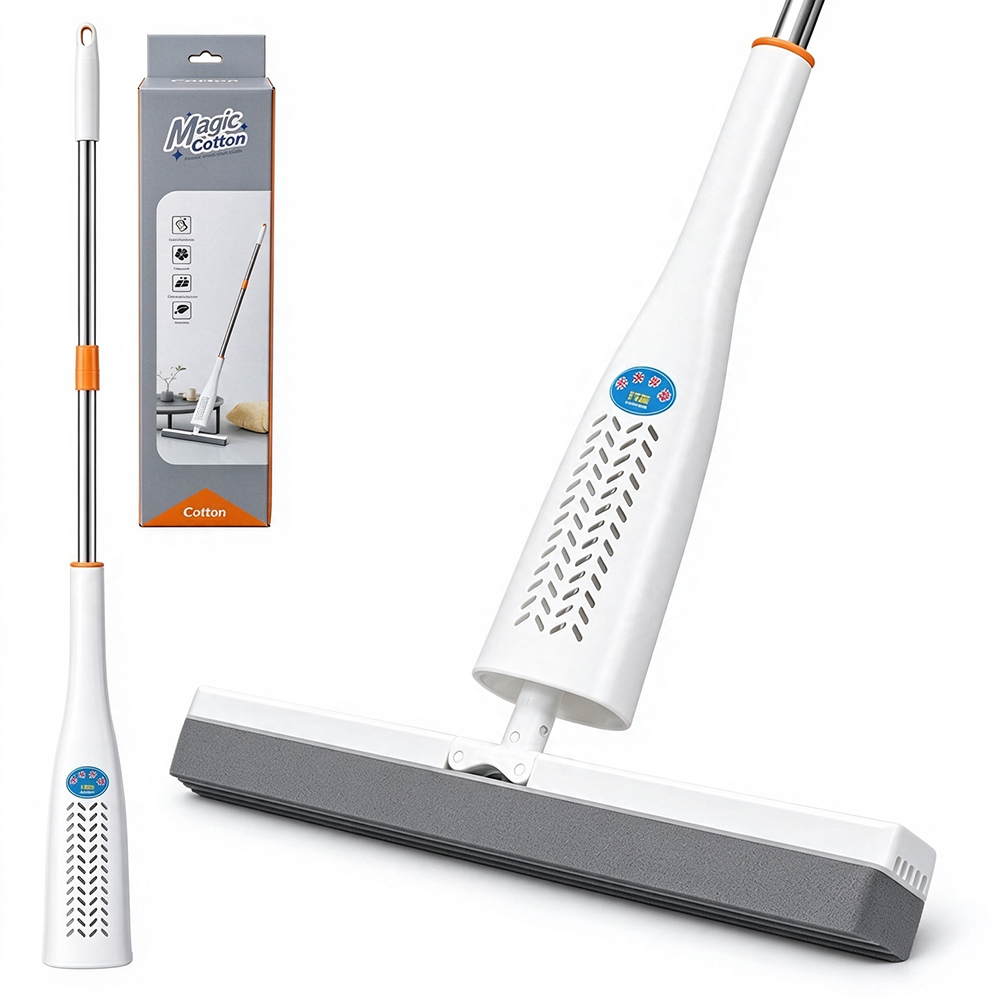
The home cleaning sector in 2026 is undergoing a deep transformation from "functional satisfaction" to "experience reconstruction." When consumers' criteria for a mop shift from "it cleans the floor" to "it doesn't dirty my hands, doesn't make me bend over, and doesn't exhaust me," a category that has long been underestimated yet precisely targets the pain points of modern households is making a strong comeback: the squeeze-drain sponge mop, commonly known among consumers as the "hands-free PVA mop." What it solves goes far beyond the act of "mopping." It redefines the relationship between people and cleaning tools—hands no longer need to touch dirty water, backs no longer need to bend repeatedly to wring out the mop head, and the cleaning process itself shifts from "something to endure" to "something acceptable." For brands and channel partners looking for product upgrade directions, understanding the underlying logic of this category's breakout is more critical than chasing any short-term traffic-driven bestseller.
Structural Growth of the Global Floor Cleaning Equipment Market: Why Manual Tools Are Still Expanding
To understand the market opportunity for squeeze-drain sponge mops, one must first see a fact that is easily overlooked: in 2026, with vacuum cleaners and wet-dry floor washers growing rapidly, manual cleaning tools have not been replaced—they are undergoing a value reshaping driven by "experience upgrading."
Data from Straits Research shows that the global floor cleaning equipment market was valued at USD 14.78 billion in 2025, projected to reach USD 15.98 billion in 2026 and grow to USD 29.79 billion by 2034, with a compound annual growth rate (CAGR) of 8.1%. Global Market Insights uses a slightly different measurement scope but reaches the same trend judgment: the global floor cleaning equipment market was approximately USD 27 billion in 2025, about USD 28.5 billion in 2026, and is expected to reach USD 49.6 billion by 2035, with a CAGR of 6.3%. Both independent research firms point to the same conclusion: floor cleaning is a rigid, continuously expanding track—not a shrinking legacy market.
What is more noteworthy is the performance of the sub-category. According to QYResearch statistics and forecasts, the global hands-free mop market sales reached USD 2.441 billion in 2025 and are projected to reach USD 3.965 billion by 2032, with a CAGR of 7.3% (2026–2032). This growth rate is higher than the average for the overall floor cleaning equipment market. The report explicitly defines a hands-free mop as a cleaning tool that "prevents users from directly contacting dirty water and dirt during use." This means "hands-free" is not an add-on feature—it is the fundamental reason this category exists.
Global floor cleaning equipment market (2025): USD 14.78 billion, projected to reach USD 29.79 billion by 2034, CAGR 8.1% — Straits Research.
Global hands-free mop market (2025): USD 2.441 billion, projected to reach USD 3.965 billion by 2032, CAGR 7.3% — QYResearch.
Home care trend: "Efficiency imperative" listed among the top five trends driving category growth — Euromonitor, July 2026.
Euromonitor, in its July 2026 report "Top Five Trends in Home Care," lists the "efficiency imperative" as one of the five major trends driving growth in the home care category. The report notes that consumers increasingly value solutions that "seamlessly integrate into busy schedules and simplify daily tasks," and that "products that reduce labor, shorten processes, and deliver reliable results under real household conditions" will become key drivers of category growth. The squeeze-drain sponge mop sits precisely at the center of this trend: it replaces hand-wringing with mechanical squeezing, replaces repeated dipping with the sponge's high water absorption, and replaces traditional physical exertion with a no-bending operation.
Why "Hands-Free" Is a "Must-Have" Rather Than a "Selling Point": Pain Point Data from Real Users
Any judgment about a product trend that is detached from real user behavior data is merely castles in the air. The value of the squeeze-drain sponge mop can be clearly validated through authoritative research institutions' quantitative analysis of consumer pain points.
In May 2026, iResearch (艾瑞咨询) conducted a survey through its consumer insight database, covering the pain points and expectations of different cleaning user groups. The data shows that among the "quality-demanding" group, hair tangling is the biggest pain point, followed by high visual cleanliness requirements and insufficient product adaptability. Among the "pragmatic silver-haired" group—consumers aged 55 and above—the survey results reveal more specific needs: their "most painful issues are repeatedly washing tools mid-mopping, hair tangling on the mop, and needing to bend over to hand-wash the mop head"—pain points "directly related to physical strength and joint burden." The most desired mop features for the silver-haired group are "no bending, no hand-washing," followed by "cleans thoroughly without leaving marks" and "can reach into corners."
For the "rental transition" group—young renters with entry-level incomes pursuing efficiency—the survey shows they "cannot tolerate hair tangling, frequent washing, streaks, and dead corners during mopping," and when purchasing cleaning tools they "value cleaning effectiveness and efficiency, seeking lightweight, durable, and hands-free cleaning tools."
The common thread across these three groups is crystal clear: touching dirty water with hands, bending to wring out the mop, and repeatedly washing the mop head are universal pain points that cut across age and income brackets. The "hand-washing" step of traditional string mops or flat mops is essentially a forced physical labor and a hygiene compromise. The mechanical squeeze structure of the squeeze-drain sponge mop fundamentally eliminates this step. Users simply place the mop head into the squeeze slot and press or step on the squeezing mechanism—water is drained, and hands never touch dirty water throughout the process. This is not a "convenience improvement"—it is the complete deletion of the most unpleasant part of the cleaning process.
The Water Absorption Logic of Sponge Material: Why It Is Better Suited for "Clean in One Pass" Than Fiber Mop Heads
The core material of the squeeze-drain sponge mop is PVA (polyvinyl alcohol) sponge, not traditional microfiber or cotton string. This material choice determines its performance advantages in specific scenarios.
Rubbermaid Commercial Products, in its technical comparison of microfiber cleaning systems, points out that the problem with traditional string mops during cleaning is that they "push dirty water around," while microfiber flat mops remove stains by having fibers "trap and lock in dust, dirt, and moisture." This principle is realized in a different way in sponge mops: PVA sponge's water absorption capacity far exceeds ordinary fibers, enabling it to rapidly draw floor moisture and dissolved stains into the sponge interior during mopping, rather than leaving them on the floor to evaporate. For scenarios like kitchens and bathrooms that require "mop and dry," this characteristic is decisive.
More importantly, the squeeze-drain method of the sponge mop and the "pad replacement" method of microfiber mops address two sides of the same problem. Microfiber systems avoid cross-contamination by "replacing dirty pads and using clean ones." Sponge mops achieve continuous cleaning by "squeezing out dirty water and restoring the sponge's absorption capacity." Both answer the same question: how to prevent the cleaning tool itself from becoming a contamination source. The process of hand-washing a mop head is precisely the moment when users are forced into direct contact with the contamination source. The squeeze-drain structure removes this contact point entirely.
A study by William A. Rutala et al., published in the American Journal of Infection Control and indexed in PubMed, compared the microbial removal effectiveness of microfiber mops versus traditional string mops. Although the study dates back to 2007, its conclusion holds reference value for understanding the importance of "tool hygiene": under conditions using a cleaning agent, the microfiber system demonstrated a superior microbial removal rate compared to string mops (95% vs. 68%). The principle this study reveals remains valid today: the material and structure of a cleaning tool directly affect its ability to remove dirt and microorganisms, and also affect the degree of user contact with contaminants during use. The hands-free design of the sponge mop essentially adds a physical barrier between the user and contaminants.
The Engineering Logic of the Squeeze-Drain Structure: Why "Mechanical Replacement of Hands" Is the Core of Product Upgrading
The technical core of the squeeze-drain sponge mop lies not in the sponge itself, but in the mechanical structure that allows the sponge to "drain without hand-wringing." The design quality of this structure directly determines whether the product is "a pleasure to use" or "a pain to use."
Currently, squeeze-drain methods on the market fall into two main categories: roller-press type and push-pull plate type. The roller-press type uses two rollers to squeeze the sponge as the mop head slides up and down, offering high drainage efficiency and labor-saving operation. The push-pull plate type uses a fixed plate moving relative to the mop head to squeeze the sponge, with a simpler structure but requiring greater operating force.
The strong preference for "no bending" among the silver-haired group in the iResearch survey directly points to the ergonomic value of the squeeze structure. The traditional wringing action requires users to bend over and exert force with their hands, placing sustained strain on the lumbar spine and wrists. The squeeze-drain structure transfers the force application to the arms and overall body movement, allowing users to complete water drainage while standing. For elderly users with joint degeneration and young renters pursuing efficiency, this difference is the dividing line between "willing to use" and "unwilling to use."
Euromonitor's efficiency trend report further confirms this judgment: consumer demand for "reducing labor and shortening processes" is becoming a core driver of category growth. What the squeeze-drain structure reduces is not just the single action of "hand-wringing"—it shortens the "interruption time" throughout the cleaning process. There is no need to stop, go to the bathroom to dump water, rinse the mop head, wring it out again, and return to the cleaning area. One squeeze restores the sponge's absorption capacity, and cleaning continues. The continuity of the process itself is a form of experiential value.
OEM and ODM: Why Customization Capability Determines the Competitive Landscape of This Category in 2026
For brands and channel partners, product trends are only half the story. The other half is: who can turn "hands-free" from a concept into a shelf-ready product that withstands repeated use, at controllable cost and reliable quality.
The manufacturing barrier for squeeze-drain sponge mops may appear low, but in reality, there are several critical quality control points: sponge density and resilience (determining absorption capacity and service life), durability of the squeeze structure (determining how long the product lasts), and load-bearing and anti-rust treatment of the pole (determining long-term user experience). Differences in these details may translate to only a few dozen yuan in retail price, but the gap in lifespan and word-of-mouth in users' hands is several times greater.
Manufacturer information showcased on the SourcingFairs platform provides an industry reference: taking Taizhou Jieba Cleaning Products Co., Ltd. as an example—an ODM enterprise established in 2011 that specializes in cleaning equipment and offers "complete machine production, OEM/ODM branding, and personalized customization services," supporting "personalized customization of product appearance, function, and parameters," with main export markets covering Europe, Africa, Asia, and other regions. The common feature of such manufacturers is: they possess complete production lines and quality control systems, and can adjust product specifications according to target market needs, rather than only offering fixed-model stock items.
OEM customization solves "what your brand needs." Brand differentiation in the squeeze-drain sponge mop category is accelerating in 2026. On one hand, traditional home cleaning brands need to expand their hardware product lines, extending from "selling cleaning agents" to "selling cleaning tools" to form complete scenario solutions. On the other hand, emerging e-commerce brands and channel private labels need products that can carry their brand identity, rather than uniform generic products. The core value of the OEM model is: you define the product with your brand—from sponge color, pole material (stainless steel, aluminum alloy, plastic-coated), squeeze structure type, to packaging design—every detail constitutes part of the brand identity.
ODM customization solves "what your market needs." Different regions and channels have significantly different requirements for squeeze mops. The European market has higher requirements for product durability and material environmental friendliness. Southeast Asian and Middle Eastern markets are more concerned about the sponge's anti-aging performance in high-temperature environments. North American consumers have clear expectations for larger mop head sizes (covering more area) and the availability of replacement sponge heads. Domestic e-commerce channels are more sensitive to "ready-to-use out of the box" assembly convenience and packaging transport safety. The value of ODM lies in the manufacturing partner's involvement from the product definition stage, adjusting core parameters according to the target market's usage habits, floor materials, and climate conditions: sponge density, squeeze force, pole length, and mop head size.
For brands planning their 2026 cleaning tool product lines, the squeeze-drain sponge mop is not a category to "give it a try." It sits at an intersection of data-validated demand: the hands-free mop market is growing at a 7.3% CAGR, consumer willingness to pay for "no dirty hands, no bending" cuts across age and income brackets, and the "efficiency" trend in home cleaning is becoming the core engine of category growth. The question is not "whether to do it," but "with what quality product, under what brand positioning, and at what price point to enter."
The essence of the squeeze-drain sponge mop is not "a better mop." It is a negation of the default assumption that "cleaning must involve enduring dirt and fatigue." When users press the squeeze mechanism and watch dirty water flow out of the sponge while their hands remain clean, the message the product conveys is: cleaning does not have to come at the expense of comfort and hygiene. In the 2026 home cleaning market, this message is more persuasive than any functional specification.



